
One dashboard for everyone in the agency is a mistake.
The information a producer needs to do their job well is not the same information an owner needs to run the business — and confusing those two views is one of the fastest ways to create tension in an insurance agency. Producers who can’t see their own numbers assume they’re being cheated. Owners who show producers everything create endless negotiation over agency financials. The fix is separation.
Here’s how to think about what each role should actually see.
What producers should see
A producer’s dashboard should answer one question: how am I doing?
At minimum:
- Real-time sales. Every policy they’ve written this month, week, and year-to-date. Not from a manager’s report — from their own dashboard, updated the moment the deal is logged.
- Commission earned. Exactly what they’ve earned so far this pay period, and year-to-date. Broken out by new business vs. renewal so they can see the mix.
- Monthly goals. Whatever target they’ve been set — premium, policy count, dollars — and where they stand against it.
- Leaderboard position. Their rank vs. teammates. Motivating in healthy doses; more on this below.
- YTD production. The big-picture number they use to compare themselves to last year.
That’s it. Five things. Every producer needs those five and shouldn’t have to ask anyone for them.
What owners should see
An owner’s dashboard should answer a different question: is the business making money?
An owner needs everything a producer sees, plus:
- Total agency sales, across all producers, all product lines, all carriers.
- Commission expense. Total dollars going out the door in producer compensation this month, this quarter, YTD.
- Salary allocation. For W-2 producers or salaried staff supporting the sales function, the allocated cost per producer.
- Service costs. What it costs to service accounts — CSR time, tools, overhead attribution.
- Producer profitability. Sales minus all attributable costs, per producer. This is where you learn which producers are actually contributing to profit and which look productive but net nothing after costs.
- Company profit. The bottom line on the sales operation — after commissions, after salary, after service, after everything.
The owner view isn’t more detailed than the producer view because owners are more important. It’s more detailed because owners are making different decisions — hiring, firing, compensation restructuring, expansion — that require the full picture.
What producers should NOT see
Just as important: the things producers shouldn’t have access to.
- Other producers’ individual commission dollars. Rank is fine. Actual dollar amounts create resentment.
- Agency margin per product line. That’s a competitive number and doesn’t affect what a producer is trying to sell today.
- Salary information about non-producing staff.
- Overhead allocation and internal cost structures.
- The owner’s compensation.
- Cash flow, receivables, tax positions, or anything else that’s owner-territory.
None of this is because producers can’t be trusted. It’s because that information doesn’t help them do their job, it creates confusion when they don’t have the full context, and it turns every conversation into a debate about agency finances instead of production.
Why role-based visibility actually drives production
There’s a common worry among owners: if I let producers see their real-time numbers, will they slack off once they hit their target?
The evidence goes the other way. Real-time visibility drives production, not the opposite. Producers who can see themselves against a target work toward it. Producers who don’t know where they stand assume they’re doing fine, and often aren’t. Leaderboards — even soft ones — create healthy internal competition when everyone can see their rank.
The rule: visibility motivates. Opacity breeds either complacency or paranoia. Neither is what you want.
The compensation transparency question
Should producers know each other’s commission rates?
This is a philosophical question every agency answers differently. Some agencies run fully transparent compensation — every producer knows every other producer’s rate. Others keep contracts confidential.
There’s no single right answer, but there’s a wrong one: pretending it’s confidential when it isn’t. Producers talk. If contracts are supposed to be confidential and they aren’t actually being kept confidential, you’ll create trust problems the day someone finds out the person next to them has a better deal for reasons that aren’t explainable.
Whichever approach you take, make sure your commission tracking system can handle it. A system that shows individual dollar amounts to producers when the culture is “we don’t share numbers” will create daily awkwardness.
How to set this up
Whatever tool you use — spreadsheet, AMS, or purpose-built software — the setup principle is the same:
- 1. Define what each role needs. Write it down before you build anything.
- 2. Restrict access at the tool level, not by policy. “Please don’t look at this tab” is not access control.
- 3. Give each role a view designed for their role. Not the same dashboard with some fields grayed out — a purpose-built view.
- 4. Make sure the numbers match. If a producer’s dashboard says one number and the owner’s shows another, trust breaks instantly. Both views should draw from the same source of truth.
- 5. Test the boundaries. Log in as a producer. Try to click into things you shouldn’t be able to see. If you can get to them, so can they.
Spreadsheets fail every one of these tests. The whole point of a purpose-built commission system is that role-based visibility is baked in from day one, not bolted on after someone accidentally shares the wrong file.
How CommishPulse handles it
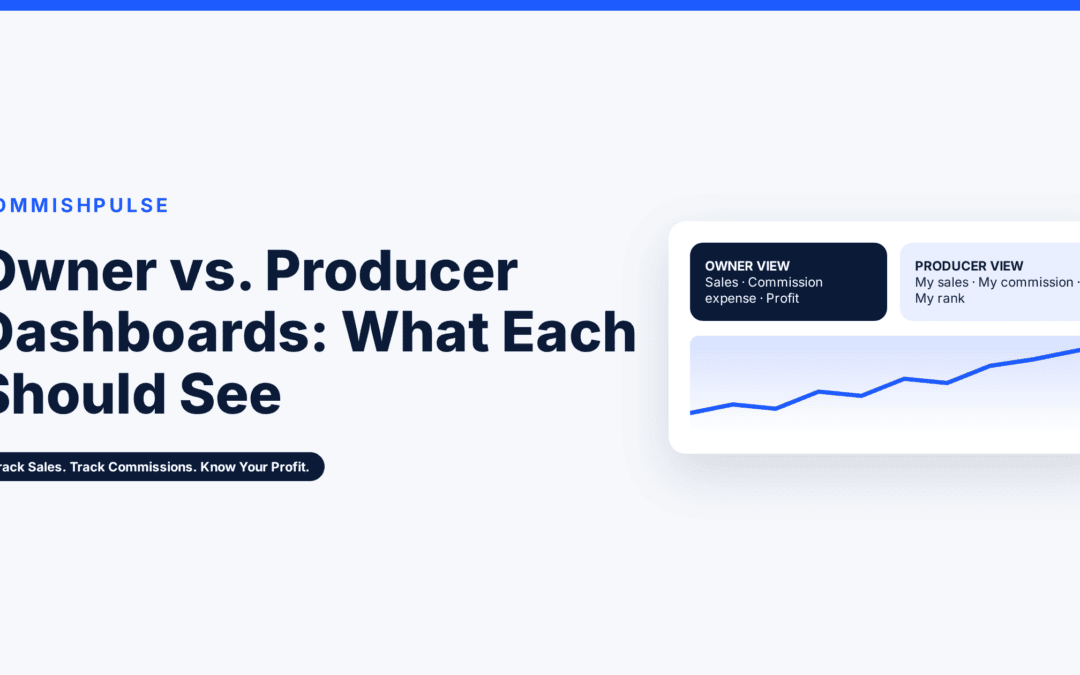
CommishPulse is built around exactly this owner-vs-producer distinction. Producers get real-time dashboards with their sales, commission, goals, and rank. Owners get everything producers see plus the full financial picture — commission expense, service costs, producer profitability, and company profit. Two views, one source of truth, permissions handled at the platform level. See pricing or how to migrate off a spreadsheet.
Frequently asked questions
Should producers see other producers’ rank on a leaderboard?
Yes, in most agencies. Healthy competition drives production. Show rank without showing individual dollar amounts.
What about team leads or sales managers — what do they see?
Depends on their role. A sales manager typically sees production numbers across their team but not full agency financials. Set up a third role between producer and owner if you need it.
Can producers see historical numbers, or just this month?
Both. Producers should be able to look at their own history — every month, every year, every deal — going back as far as the system has data. It’s their production; they should own their record.
What about clients — do they see anything?
Nothing commission-related. Clients see their own policies and service history, but commission structure is internal.
What if a producer wants to know exactly how their commission was calculated on a specific policy?
Show them. Every commission calculation should be auditable back to the source deal, the rate applied, and any adjustments. Transparency at that level builds trust. Opacity creates disputes.
Ready to give producers real-time visibility without exposing agency financials?
CommishPulse gives producers a purpose-built dashboard for their own sales, commission, goals, and rank — while owners get the full financial picture on a separate view. Same source of truth, two role-appropriate views, no accidental data leaks.

Track Sales. Track Commissions.
Know Your Profit.
Industries
© 2026 CommishPulse. All rights reserved.