
If your producers are paid the same rate on renewals as they are on new business, one of two things is probably true: your agency is losing more money than it should, or your producers are earning less than they’ve realized.
The way you split commission between new business and renewals is one of the most important structural decisions an insurance agency makes. It shapes how your producers spend their time, which accounts they nurture, and how profitable your book actually is. Here’s how it works.
Why new business and renewals deserve different rates
New business and renewals are fundamentally different work.
New business is prospecting, quoting, negotiating, underwriting, and closing. It’s expensive time. The producer is spending hours per policy and the agency is spending money on marketing, tools, and CRM to get that lead in the door.
Renewals are retention. The client is already on the book. The work is real — servicing, remarketing, re-quoting, handling claims — but it’s a fraction of what it took to bring the account in.
If both are paid at the same rate, one of two distortions happens:
- 1. Producers focus disproportionately on hunting new business because every hour spent on renewals is “wasted” at the same rate.
- 2. Or (worse) producers coast on renewals because the money keeps showing up without new effort.
Neither is what you want. The right structure aligns producer incentives with what the agency actually needs at each stage.
The four most common commission structures
Every agency’s structure is a variation on one of these four models. Numbers are illustrative — plug in your own.
Model 1: Flat rate on everything
Producer gets, say, 40% of agency commission on every policy, new or renewal.
When it works: very small agencies, or when a producer is essentially building a personal book from scratch and needs simple, predictable compensation to start.
When it breaks: as soon as the book grows. Producers with big renewal books make significantly more than producers writing hard new business, even when the newer producer is doing more work. Turnover follows.
Model 2: Higher new business rate, lower renewal rate
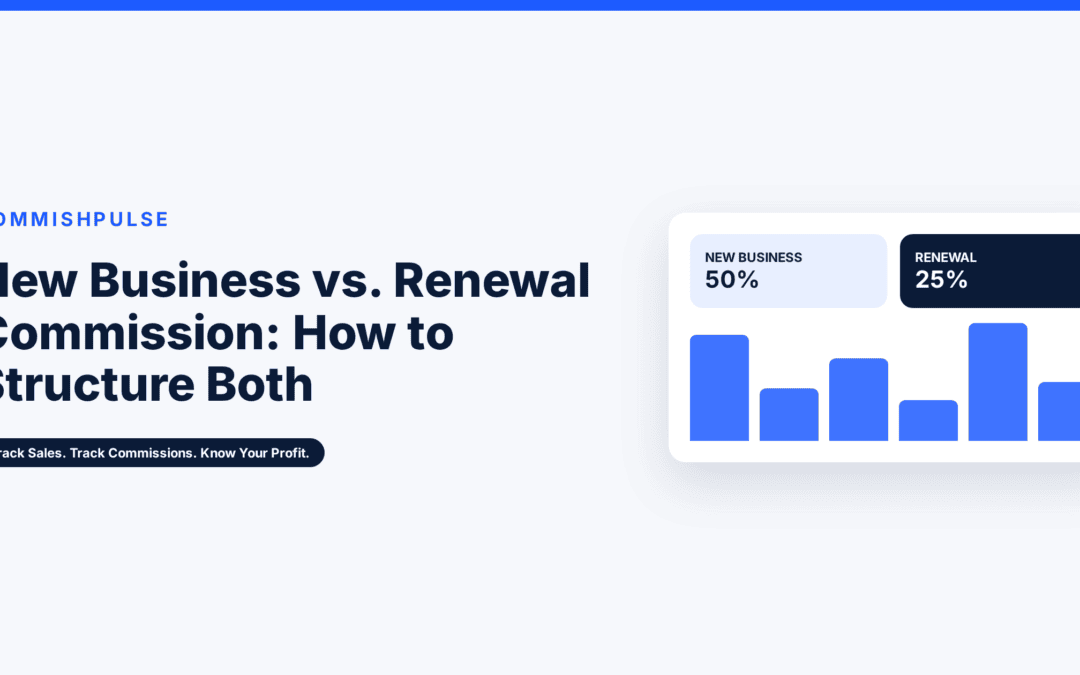
Producer gets 50% on new business and 25% on renewals.
When it works: most established agencies. Rewards prospecting effort, still pays producers meaningfully on the book they’ve built.
When it breaks: if the split is too extreme (e.g., 60% new / 10% renewal), producers stop caring about retention and your loss ratio suffers.
Model 3: Tiered new business, flat renewal
New business is tiered — 40% up to $50k premium/month, 50% above — and renewals are a flat 20%.
When it works: agencies pushing aggressive growth. Higher tiers create real motivation for high performers.
When it breaks: low performers get discouraged if the top tier feels unreachable. Watch your bottom quartile.
Model 4: Producer-owned book vs. house book
A producer who brings in an account owns the renewal commission at a higher rate (say 40%). A producer who inherits a house-book renewal gets a lower rate (say 15%).
When it works: agencies that want to reward entrepreneurial producers building their own books while still incentivizing service on inherited accounts.
When it breaks: it’s the most complex to track. If your tracking system can’t distinguish ownership at the account level, don’t try to run this model.
How to pick the right structure for your agency
Ask three questions:
1. What do you need more of right now — new business, retention, or both?
If your book is churning, the answer is retention, and your renewal rate needs to be high enough that producers actually service accounts. If your growth has stalled, new business needs to be structurally more attractive than renewals.
2. What can your margins actually support?
A common mistake is running the numbers on new business rates without checking that renewals are still profitable at scale. If your renewal rate + service costs eat all the agency commission, you’re running a break-even book.
3. Can your tracking system handle the complexity?
If you’re running a flat-rate spreadsheet, don’t jump straight to tiered new business + house-book vs. personal-book renewals. Your system won’t survive it. Fix the tracking first — here’s a walkthrough on that — and then layer complexity onto a system that can handle it.
How to communicate the structure to your team
Whatever structure you land on, put it in writing. Every producer needs a document that says:
- Their new business rate
- Their renewal rate
- Any tenure adjustments
- Split rules on shared accounts
- Override situations (if any)
- When and how commissions are paid out
- What happens if a policy cancels
The document isn’t for legal protection (though it helps). It’s so nobody is guessing. Half of all producer disputes about commission come from producers and owners having different memories of what was verbally agreed to two years ago.
How to track it without going crazy
This is where most agencies fail even after they’ve defined a great structure. Spreadsheets can’t cleanly separate new business from renewal rates on hundreds of policies a month. And when the tracking gets sloppy, producers stop trusting the numbers — and once trust breaks, the cost of the mistakes is far bigger than the mistakes themselves.
The system needs to:
- Tag every policy as new business or renewal at entry
- Apply the correct rate automatically based on producer + policy type
- Handle splits with exact percentages
- Show producers their new vs. renewal breakdown in their own dashboard
- Show owners the profit picture across the whole book
CommishPulse does exactly this, but the important thing isn’t the tool — it’s that you have some system built for the complexity of insurance commission structures instead of forcing a spreadsheet to do a job it wasn’t designed for.
Frequently asked questions
What’s a typical new business vs. renewal ratio?
For most established P&C agencies, something like 50%/25% is common. Life insurance agencies often use much higher new-business rates (sometimes 100% first-year) with much lower or trailing renewal rates. Health and benefits agencies vary widely. There’s no single industry standard.
Should the renewal rate ever be zero?
Some agencies pay first-year commission only, especially on certain life products, and reassign the renewal to the house book. This is workable but creates a service problem — producers have no incentive to keep the client happy after year one. Handle carefully.
What happens when a producer leaves?
That’s determined by your producer contract, not your commission structure. Most agencies have a vesting rule that says trailing renewals stop at termination or step down over time. Get this in writing before you need it.
Can I change the structure after producers have been paid one way for years?
You can, but you’ll create friction. The cleanest way is to grandfather existing accounts under the old rate and apply the new structure to all new business going forward.
Do split accounts pay both producers full rate on renewal?
Only if that’s how you’ve defined it. Typically split accounts pay each producer their percentage of the renewal commission indefinitely, but that’s a choice — some agencies split for one year and revert to house ownership after.
Ready to run any commission structure without breaking your tracking?
CommishPulse handles flat rates, tiered structures, splits, overrides, and separate new vs. renewal logic — for every producer, on every policy, in real time. Set your structure once and let the software apply it automatically.

Track Sales. Track Commissions.
Know Your Profit.
Industries
© 2026 CommishPulse. All rights reserved.