
An overpaid commission is not just an overpaid commission. It’s the tip of a much larger iceberg — one that sinks agencies quietly, over years, without anyone realizing it’s happening.
Here’s what commission errors actually cost you.
The direct cost: overpayments and underpayments
Start with the obvious.
Every commission error is either money you shouldn’t have paid or money you owe and haven’t. In a spreadsheet-based agency, a 2–3% error rate on commission calculations is realistic — some going one way, some the other.
At an agency writing $1.5M in annual premium with a 30% average agency commission, that’s $450k in commission to allocate. A 2% error rate means $9,000 a year in calculations that are wrong. If half go the producer’s way and half go the agency’s way, the net loss is small, but the gross impact — the amount of money moving incorrectly — is $9,000. And that’s before you count the cost of finding and fixing them.
Errors don’t self-correct. They just accumulate.
The turnover cost
This is the one nobody puts on a spreadsheet.
Producers pay attention to commission. A producer who catches an underpayment once assumes it happened last month too. A producer who catches it twice starts to distrust the whole system. A producer who catches it three times starts talking to your competitors.
The cost of losing a producer with a $500k book — recruiting, training, book transition, service disruption, potential client attrition — is in the tens of thousands of dollars. If commission errors contribute to one producer departure every few years, they’ve already cost you more than any commission software would in a decade.
The reverse also happens. Producers who catch consistent overpayments in their favor don’t say anything, and now you’ve built a compensation structure you can’t afford to sustain.
The reconciliation cost
Someone at your agency spends hours every month reconciling commissions. Sometimes it’s you. Sometimes it’s an office manager. Sometimes it’s a bookkeeper you’re paying by the hour.
Let’s do the math. If reconciliation takes eight hours a month and the person doing it costs the agency $50/hour fully loaded, that’s $400/month, or $4,800/year, just to catch and fix commission math.
That $4,800 is a soft number that never appears as a line item. It’s paid instead in vanished evenings, delayed month-end closes, and postponed strategic work. Every hour spent reconciling commissions is an hour not spent growing the book, retaining clients, or improving how the agency runs.
The trust cost
The most damaging cost, because it doesn’t have a dollar figure.
When commissions are wrong, producers stop trusting the numbers. When producers stop trusting the numbers, they stop trusting the process. When they stop trusting the process, they start:
- Keeping their own shadow spreadsheets
- Auditing every check
- Asking for meetings to “walk through my check”
- Assuming they’re being underpaid
- Assuming other producers are being favored
- Comparing checks with each other
None of this shows up on a P&L. All of it shows up in the culture of the agency, the length of your producer tenures, and the amount of your time you spend defending numbers instead of leading.
A quick math example
Let’s put it together with a plausible mid-sized agency.
- $1.5M in annual written premium
- 5 producers
- $450k in gross agency commission
- Commission error rate: 2% (realistic for spreadsheet tracking)
- Owner reconciliation time: 8 hours/month
- One producer departure over 5 years partially attributed to commission trust issues
Rough cost:
- Direct error losses (net): probably $2,000–$4,000/year
- Reconciliation time: $4,800/year × 5 years = $24,000
- Producer turnover: $30,000–$60,000 in transition costs
- Trust cost: unquantifiable but real
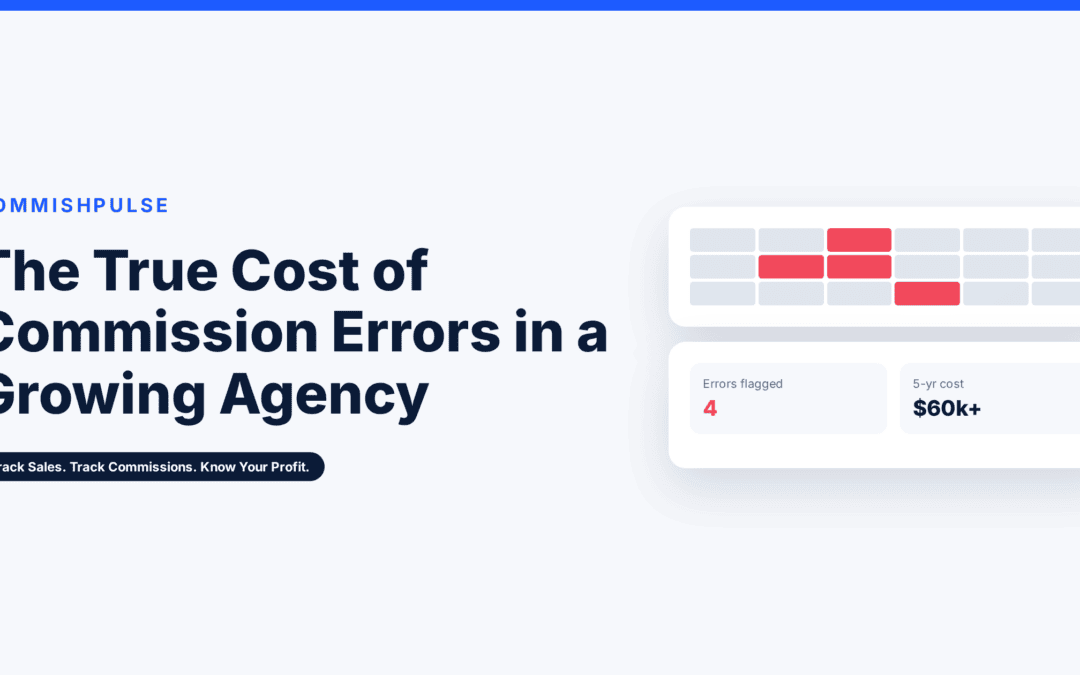
Five-year cost of commission error tolerance at this agency: $60,000–$90,000.
For comparison, a purpose-built commission tracking platform costs a fraction of that over the same period, and eliminates most of the error rate.
Where the errors actually come from
Understanding the source of errors is the first step to eliminating them. The recurring sources:
- Wrong rate applied. New business rate used on a renewal, or vice versa. Handled by structuring new vs. renewal rates cleanly.
- Wrong split percentage. “It’s about 50/50” applied inconsistently across policies.
- Duplicate entries. Same policy entered twice, paid twice.
- Missing overrides. Agency principal override forgotten on a house-book account.
- Formula errors. Spreadsheet formula dragged wrong, referenced the wrong cell, or overwritten with hardcoded numbers.
- Timing errors. Commission paid before the carrier actually funded it, or delayed past when it was earned.
- Carrier rate changes. Carrier updates a commission schedule; agency spreadsheet doesn’t get updated.
Most of these are eliminated the moment commission calculation moves out of a spreadsheet and into a rules-based system that applies the correct rate to every policy automatically.
How to eliminate most of them
The fastest way to reduce commission errors is to remove the manual math step entirely. If a producer’s contract terms are entered once and applied automatically to every deal that producer writes, most of the error sources above simply can’t happen.
That’s the argument for purpose-built tracking. Not “spreadsheets are bad” — they’re fine for what they are — but “manual calculation of commissions at scale generates errors, and errors cost more than the tool that would prevent them.”
Full walkthrough of what to do about it: how to track insurance agent commissions without spreadsheets. Or for a direct look at how CommishPulse handles all of this in one place, take a look at the product.
Frequently asked questions
How do I know if my agency has a commission error problem?
If nobody has audited a full month’s commission calculations against the source data in the last year, you have a problem — you just don’t know its size. Audit one month. If you find zero errors, congratulations. If you find any, extrapolate.
Can I just be more careful with the spreadsheet?
Care helps, but every human system has an error rate, and commission spreadsheets get complicated fast. The solution isn’t more care — it’s removing the manual calculation step.
Do producers actually notice errors?
Yes. Consistently. Producers track their own numbers informally almost every time, and they compare to the check they receive. They catch far more errors than owners realize, and they only mention a fraction of them.
Is this really about the software, or something bigger?
Both. Better software fixes the math. But the underlying issue is that manual tracking scales poorly, and every agency eventually hits the point where the manual approach costs more than replacing it.
Isn’t some error rate inevitable?
In any system, yes. But there’s a difference between the 0.1% error rate of an automated rules-based system and the 2–3% error rate of a spreadsheet. That difference is where the money is.
Ready to eliminate commission errors before they cost you a producer?
CommishPulse applies every producer’s contract terms automatically to every deal, catches duplicates before they become double payouts, and gives you an auditable record of every calculation. Stop paying for errors you don’t know are happening.

Track Sales. Track Commissions.
Know Your Profit.
Industries
© 2026 CommishPulse. All rights reserved.